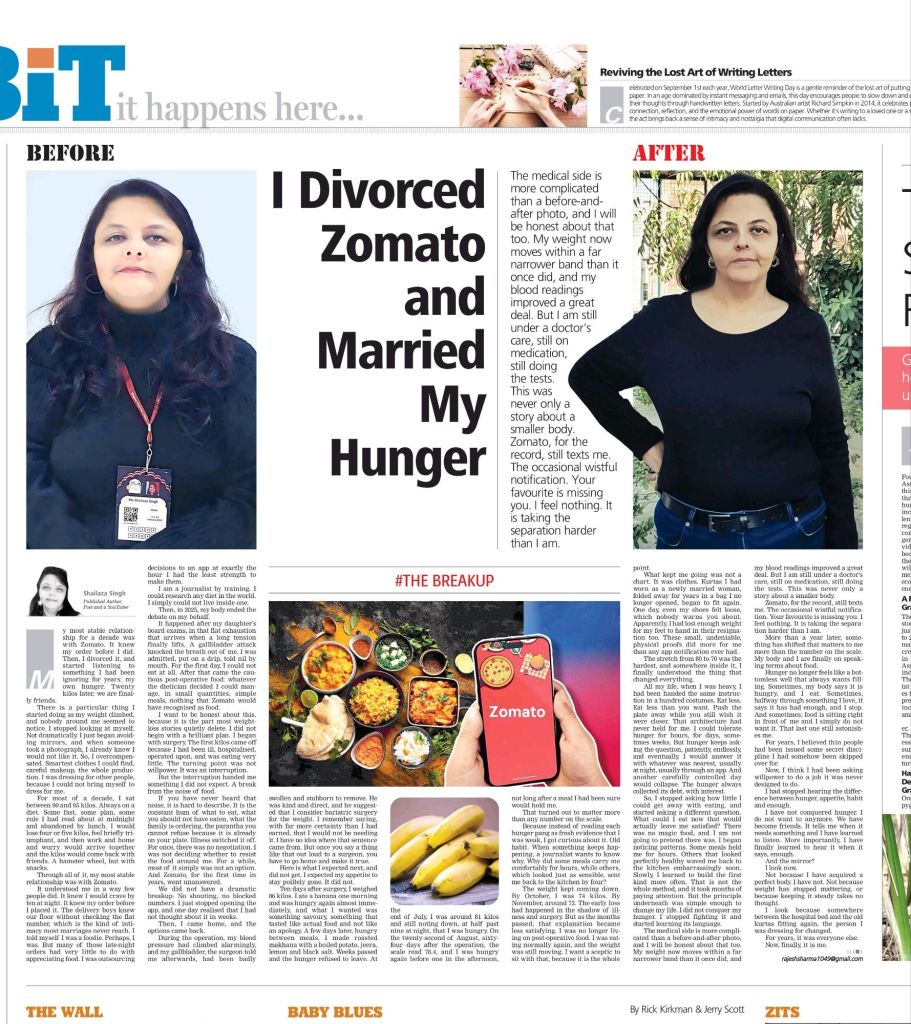
My most stable relationship for a decade was with Zomato. It knew my order before I did. Then I divorced it, and started listening to something I had been ignoring for years: my own hunger. Twenty kilos later, we are finally friends.
There is a particular thing I started doing as my weight climbed, and nobody around me seemed to notice. I stopped looking at myself. Not dramatically. I just began avoiding mirrors, and when someone took a photograph, I already knew I would not like it. So I overcompensated. Smartest clothes I could find, careful makeup, the whole production. I was dressing for other people, because I could not bring myself to dress for me.
For most of a decade I sat between 90 and 95 kilos. Always on a diet. Some fast, some plan, some rule I had read about at midnight and abandoned by lunch. I would lose four or five kilos, feel briefly triumphant, and then work and home and worry would arrive together and the kilos would come back with friends. A hamster wheel, but with snacks.
Through all of it, my most stable relationship was with Zomato.
It understood me in a way few people did. It knew I would cave by ten at night. It knew my order before I placed it. The delivery boys knew our floor without checking the flat number, which is the kind of intimacy most marriages never reach. I told myself I was a foodie. Perhaps I was. But many of those late-night orders had very little to do with appreciating food. I was outsourcing decisions to an app at exactly the hour I had the least strength to make them.
I am a journalist by training. I could research any diet in the world. I simply could not live inside one.
Then, in 2025, my body ended the debate on my behalf.
It happened after my daughter’s board exams, in that flat exhaustion that arrives when a long tension finally lifts. A gallbladder attack knocked the breath out of me. I was admitted, put on a drip, told nil by mouth. For the first day I could not eat at all. After that came the cautious post-operative food: whatever the dietitian decided I could manage, in small quantities, simple meals, nothing that Zomato would have recognised as food.
I want to be honest about this, because it is the part most weight-loss stories quietly delete. I did not begin with a brilliant plan. I began with surgery. The first kilos came off because I had been ill, hospitalised, operated upon, and was eating very little. The turning point was not willpower. It was an interruption.
But the interruption handed me something I did not expect. A break from the noise of food.
If you have never heard that noise, it is hard to describe. It is the constant hum of what to eat, what you should not have eaten, what the family is ordering, the parantha you cannot refuse because it is already on your plate. Illness switched it off. For once there was no negotiation. I was not deciding whether to resist the food around me. For a while, most of it simply was not an option. And Zomato, for the first time in years, went unanswered.
We did not have a dramatic breakup. No shouting, no blocked numbers. I just stopped opening the app, and one day realised I had not thought about it in weeks.
Then I came home, and the options came back.
During the operation my blood pressure had climbed alarmingly, and my gallbladder, the surgeon told me afterwards, had been badly swollen and stubborn to remove. He was kind and direct, and he suggested I consider bariatric surgery for the weight. I remember saying, with far more certainty than I had earned, that I would not be needing it. I have no idea where that sentence came from. But once you say a thing like that out loud to a surgeon, you have to go home and make it true.
Here is what I expected next, and did not get. I expected my appetite to stay politely gone. It did not.
Ten days after surgery I weighed 86 kilos. I ate a banana one morning and was hungry again almost immediately, and what I wanted was something savoury, something that tasted like actual food and not like an apology. A few days later, hungry between meals, I made roasted makhana with a boiled potato, jeera, lemon and black salt. Weeks passed and the hunger refused to leave. At the end of July I was around 81 kilos and still noting down, at half past nine at night, that I was hungry. On the twenty-second of August, sixty-four days after the operation, the scale read 78.4, and I was hungry again before one in the afternoon, not long after a meal I had been sure would hold me.
That turned out to matter more than any number on the scale.
Because instead of reading each hunger pang as fresh evidence that I was weak, I got curious about it. Old habit. When something keeps happening, a journalist wants to know why. Why did some meals carry me comfortably for hours, while others, which looked just as sensible, sent me back to the kitchen by four?
The weight kept coming down. By October I was 74 kilos. By November, around 72. The early loss had happened in the shadow of illness and surgery. But as the months passed, that explanation became less satisfying. I was no longer living on post-operative food. I was eating normally again, and the weight was still moving. I want a sceptic to sit with that, because it is the whole point.
What kept me going was not a chart. It was clothes. Kurtas I had worn as a newly married woman, folded away for years in a bag I no longer opened, began to fit again. One day even my shoes felt loose, which nobody warns you about. Apparently I had lost enough weight for my feet to hand in their resignation too. These small, undeniable, physical proofs did more for me than any app notification ever had.
The stretch from 80 to 70 was the hardest, and somewhere inside it I finally understood the thing that changed everything.
All my life, when I was heavy, I had been handed the same instruction in a hundred costumes. Eat less. Eat less than you want. Push the plate away while you still wish it were closer. That architecture had never held for me. I could tolerate hunger for hours, for days, sometimes weeks. But hunger keeps asking the question, patiently, endlessly, and eventually I would answer it with whatever was nearest, usually at night, usually through an app. And another carefully controlled day would collapse. The hunger always collected its debt, with interest.
So I stopped asking how little I could get away with eating, and started asking a different question. What could I eat now that would actually leave me satisfied? There was no magic food, and I am not going to pretend there was. I began noticing patterns. Some meals held me for hours. Others that looked perfectly healthy waved me back to the kitchen embarrassingly soon. Slowly, I learned to build the first kind more often. That is not the whole method, and it took months of paying attention. But the principle underneath was simple enough to change my life. I did not conquer my hunger. I stopped fighting it and started learning its language.
The medical side is more complicated than a before-and-after photo, and I will be honest about that too. My weight now moves within a far narrower band than it once did, and my blood readings improved a great deal. But I am still under a doctor’s care, still on medication, still doing the tests. This was never only a story about a smaller body.
Zomato, for the record, still texts me. The occasional wistful notification. Your favourite is missing you. I feel nothing. It is taking the separation harder than I am.
More than a year later, something has shifted that matters to me more than the number on the scale. My body and I are finally on speaking terms about food.
Hunger no longer feels like a bottomless well that always wants filling. Sometimes my body says it is hungry, and I eat. Sometimes, halfway through something I love, it says it has had enough, and I stop. And sometimes food is sitting right in front of me and I simply do not want it. That last one still astonishes me.
For years I believed thin people had been issued some secret discipline I had somehow been skipped over for.
Now I think I had been asking willpower to do a job it was never designed to do.
I had stopped hearing the difference between hunger, appetite, habit and enough.
I have not conquered hunger. I do not want to anymore. We have become friends. It tells me when it needs something and I have learned to listen. More importantly, I have finally learned to hear it when it says, enough.
And the mirror?
I look now.
Not because I have acquired a perfect body. I have not. Not because weight has stopped mattering, or because keeping it steady takes no thought.
I look because somewhere between the hospital bed and the old kurtas fitting again, the person I was dressing for changed.
For years, it was everyone else.
Now, finally, it is me.
Shailaza Singh is a Jaipur-based writer, journalist and former editor-in-chief. Her book, Feed Hunger, Lose Weight, grew out of her experience of losing close to twenty kilos and her subsequent exploration of hunger, satiety and ordinary Indian home food.
 My Fat Loss Journey